1. One Model for Enterprise Multimodal Agent Workflows
Enterprise AI agents are no longer text-only systems. Real enterprise workflows include PDFs, screenshots, application screens, videos, audio recordings, scanned documents, dashboards, tickets, logs, and business systems.
Until now, most organizations built multimodal agents by stitching together separate models:
OCR for documents, ASR for speech, vision models for images, video models for clips, LLMs for reasoning, and tool agents for actions. This approach works, but it creates latency, cost, complexity, and context loss.
NVIDIA Nemotron 3 Nano Omni introduces a cleaner architecture: one unified multimodal model that can see, hear, read, and reason inside a single agent loop. It is best used as a multimodal perception and reasoning sub-agent inside a larger enterprise agent architecture.
2. The Architecture Shift: From Model Pipelines to Multimodal Sub-Agents
Traditional enterprise AI architecture often looks like this:
- PDF to OCR model to text extraction to LLM
- Audio to ASR model to transcript to LLM
- Screenshot to vision model to UI parser to LLM
- Video to frame sampling to video model to LLM
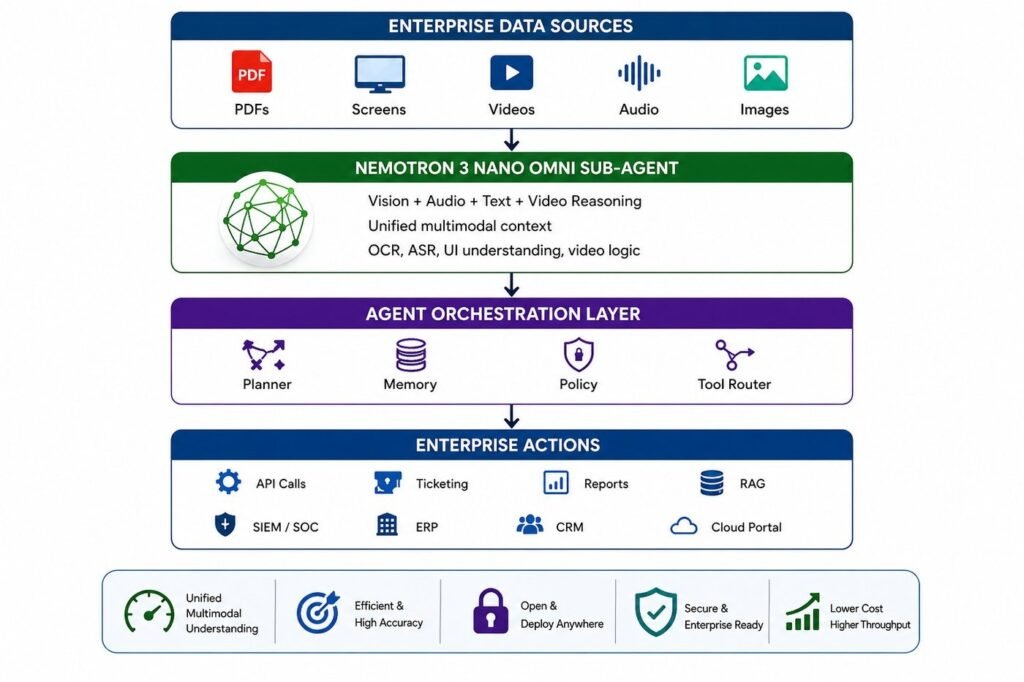
Every handoff adds delay. Every model requires separate deployment, monitoring, scaling, cost control, and governance. Nemotron 3 Nano Omni changes the design pattern by replacing fragmented perception pipelines with a unified multimodal sub-agent.
The new pattern is simple: multimodal input flows into the Omni sub-agent, the sub-agent produces structured understanding, and the planner decides which tool or workflow should be executed next.
3. Core Enterprise Roles
3.1 Nemotron 3 Nano Omni Sub-Agent
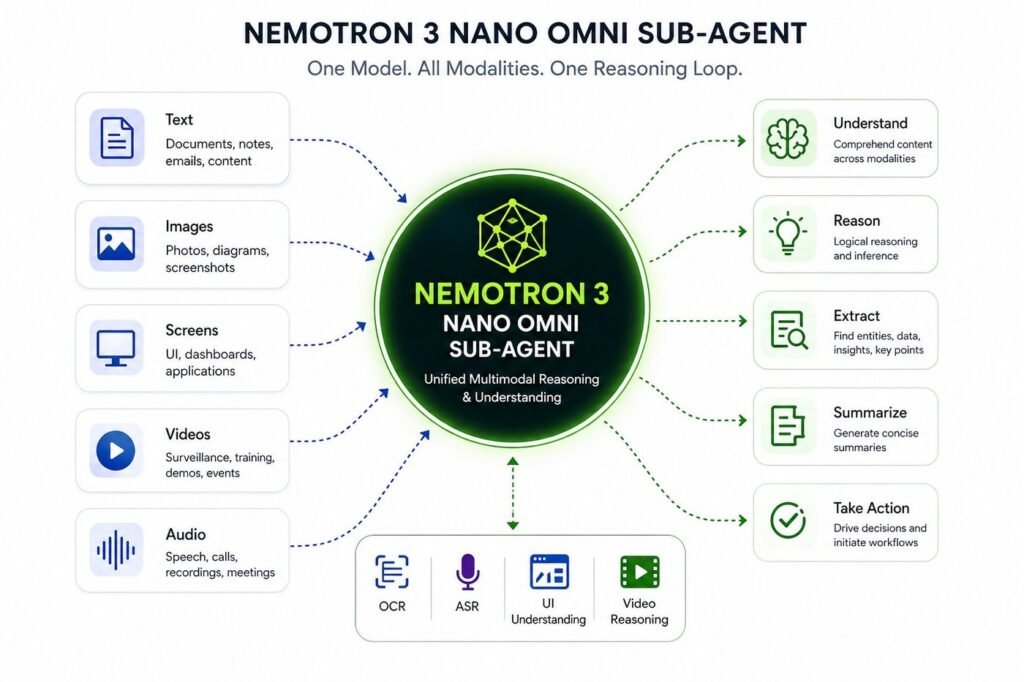
The Omni sub-agent handles multimodal understanding. It reads documents, understands screens, processes images, interprets audio, and reasons over video. Its role is not only extraction, but context formation.
3.2 Planner Model
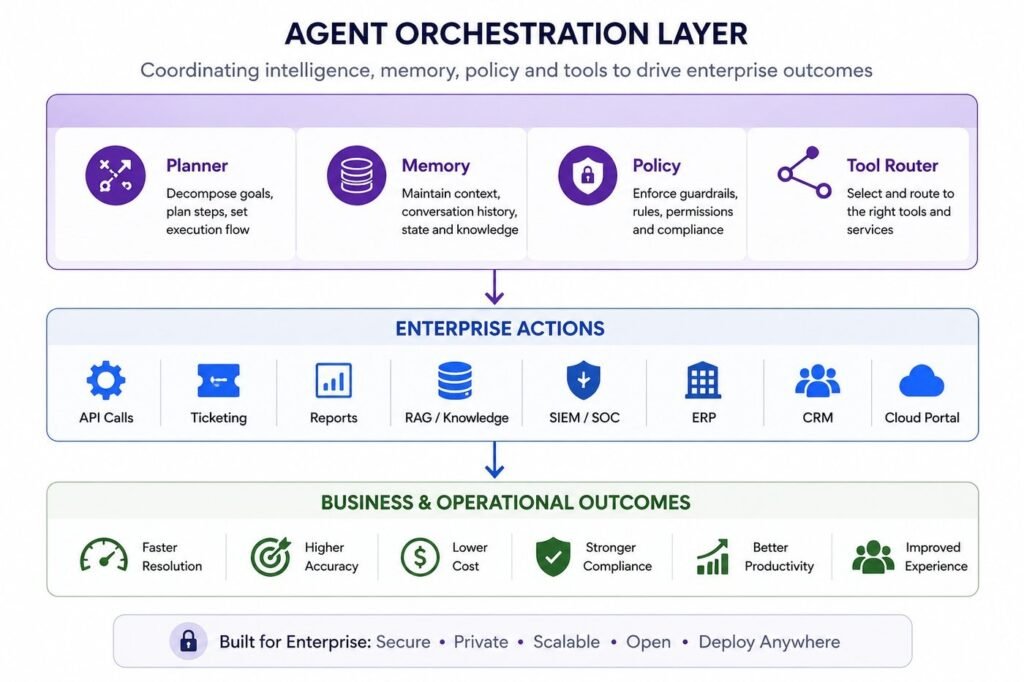
The planner decides what should happen next. It decomposes the task, prioritizes steps, decides whether human approval is required, and determines which enterprise tool should be called.
3.3 Tool Executor
The executor performs the action. It may call APIs, create tickets, update CRM records, trigger SIEM/SOC workflows, generate reports, or interact with cloud portals.
3.4 Policy and Guardrail Layer
The policy layer controls permissions, compliance, audit, data residency, approval workflows, and safety boundaries. This is critical for enterprise adoption because multimodal agents should not directly execute sensitive actions without policy checks.
3.5 Memory and RAG Layer
The memory layer stores enterprise context, SOPs, prior tickets, logs, knowledge-base articles, past actions, and evidence. This allows the agent to reason with organizational history, not just the current prompt.
4. Production Deployment Blueprint
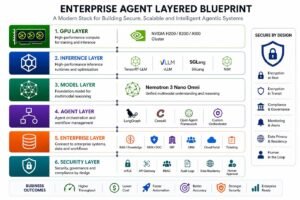
A production-grade enterprise stack should be built in layers. This keeps the model layer independent from the inference runtime, agent orchestration framework, enterprise integrations, and security controls.
| Layer | Recommended Components |
| GPU Layer | NVIDIA H200, B200, or A100 cluster |
| Inference Layer | TensorRT-LLM, vLLM, SGLang, NIM |
| Model Layer | Nemotron 3 Nano Omni |
| Agent Layer | LangGraph, CrewAI, Open Agent Framework, or custom orchestrator |
| Enterprise Layer | RAG, SIEM, ERP, CRM, Cloud Portal, Ticketing |
| Security Layer | mTLS, API Gateway, RBAC, audit logs, data residency, human approval |

5. Why This Matters for Enterprises
Lower Latency
A single multimodal model reduces the number of inference hops across OCR, ASR, vision, video, and language models.
Lower Cost
Fewer models mean fewer endpoints, fewer GPUs, simpler scaling, and reduced operational overhead.
Better Context
The same model can reason across modalities without losing context between separate systems.
Stronger Security
Sensitive documents, videos, recordings, and screenshots can remain inside private infrastructure or sovereign cloud environments.
Easier Operations
One unified architecture is easier to monitor, secure, scale, and govern.
6. Enterprise Use Cases
SOC and NOC Command Center
The agent reviews screenshots from Grafana, Zabbix, Wazuh alerts, firewall logs, and incident recordings. It summarizes the issue, correlates evidence, and opens a ticket with recommended actions.
Document Intelligence
The agent reads RFPs, contracts, invoices, compliance reports, technical manuals, and scanned forms. It extracts entities, identifies risks, summarizes clauses, and prepares structured outputs.
Healthcare Workflow Automation
The agent analyzes call recordings, patient forms, appointment notes, reports, and workflow screens. It helps route cases, summarize interactions, and support administrative automation.
Cloud Portal Operations
The agent observes UI screens, reads error messages, validates provisioning status, checks tenant resources, and routes remediation through approved APIs.
Training and Video Intelligence
The agent reviews training videos, meeting recordings, demos, surveillance clips, and operational footage, then creates summaries, action items, and compliance evidence.
7. Security Architecture
For enterprise and sovereign AI deployments, Nemotron 3 Nano Omni should sit behind a controlled API and security layer. The model may reason, but the policy layer must authorize.
- API Gateway
- mTLS
- RBAC
- Tenant isolation
- Audit logs
- Data residency controls
- Prompt and output logging
- Human approval for sensitive actions
- SIEM/SOC integration
- Policy-based tool execution
8. Final Positioning
NVIDIA Nemotron 3 Nano Omni is not just another multimodal model. It is an enterprise sub-agent engine for building AI systems that can see, hear, read, understand, and reason across real business data.
For organizations building sovereign AI clouds, private AI platforms, SOC/NOC automation, healthcare agents, document intelligence, and enterprise workflow automation, the architecture is clear: multimodal input flows into Nemotron 3 Nano Omni, the planner and policy layer decide what should happen, and the tool executor safely performs enterprise actions.
This is the future of enterprise agent architecture: fewer model silos, faster reasoning, lower cost, stronger governance, and one unified multimodal intelligence layer.
References
- NVIDIA Developer Blog: NVIDIA Nemotron 3 Nano Omni Powers Multimodal Agent Reasoning in a Single Efficient Open Model.
- NVIDIA Nemotron model family and data pipeline overview.
- NVIDIA NIM, TensorRT-LLM, vLLM, and SGLang deployment ecosystem documentation.